My research focuses on multi-level governance and comparative federalism, with a particular emphasis on the political systems of Canada and the European Union, as well as on international and comparative environmental politics. I am also interested in the application of comparative methodologies in Canadian and EU studies.
Research areas
- comparative politics
- comparative federalism
- Canadian politics
- EU politics
- comparative public policy
- international compliance and implementation
- international and comparative environmental and climate politics
- comparative methodology
Methodological expertise
- comparative methodology
- mixed-methods designs
- Qualitative Comparative Analysis
- process-tracing
- case studies
- interviews
Research axes
My current research follows two main axes. First, I study how federal structures affect public policies. I am particularly interested in how intergovernmental institutions shape the role of federated governments, such as Canadian provinces, in the coordination of internationalized public policies, with a current focus on environmental protection. Second, I aim to refine how we study federal and multi-level systems. I am currently examining the extent to which comparative federalism, Canadian political science, and EU studies have embraced comparative perspectives. This work reflects my conviction that political systems often considered sui generis can be better understood when situated in a broader comparative context.
Publications
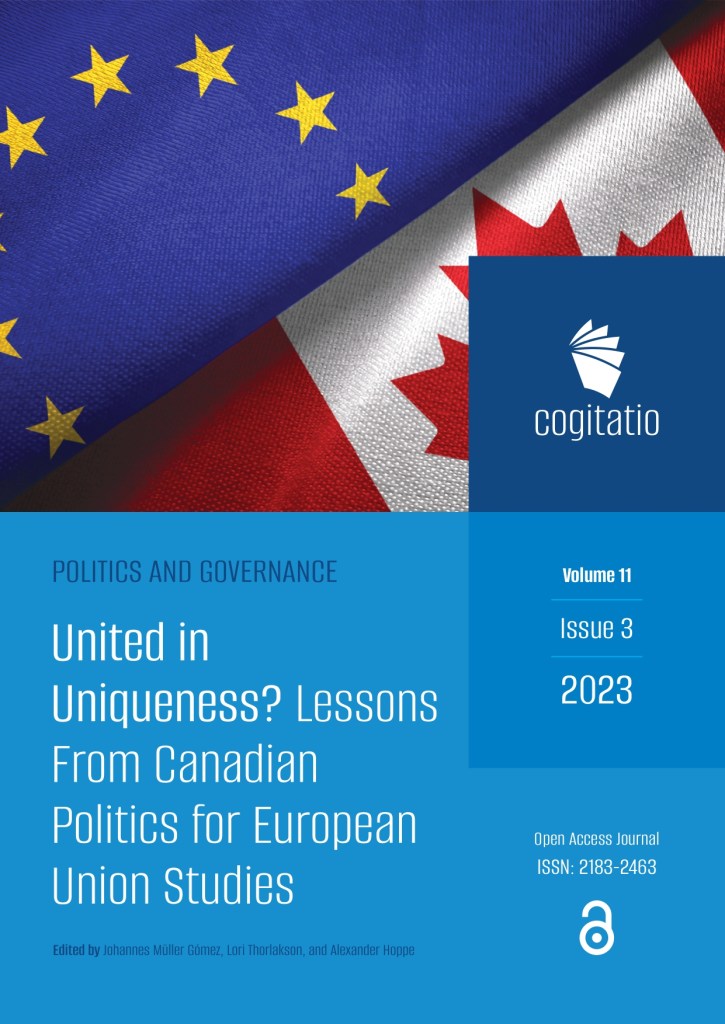
My recent publications include a special issue of Politics and Governance on the merits and challenges of comparing Canada and the European Union, which I co-edited with Lori Thorlakson (University of Alberta) and Alexander Hoppe (University of Duisburg-Essen). By comparing the two systems in terms of polity, politics, and policy, the issue demonstrates the benefits that both Canadian political science and EU studies can gain from engaging in comparative exercises.
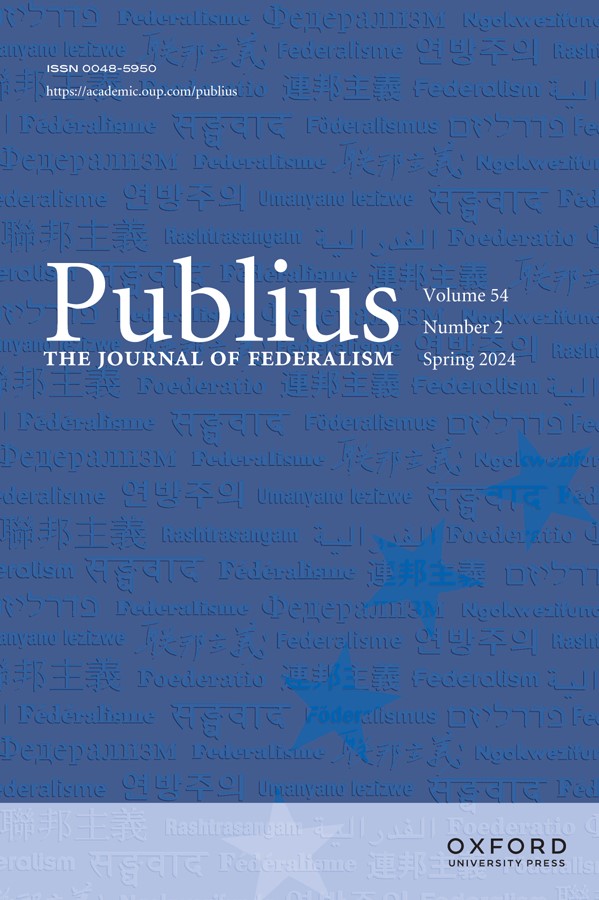
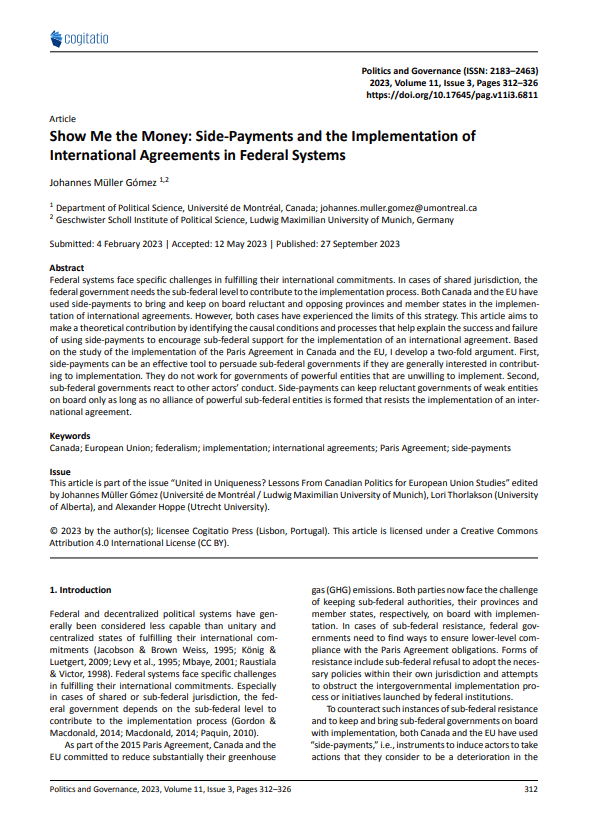
I have also recently published an article in Publius – The Journal of Federalism on how multi-level structures affect the fulfilment of international commitments, challenging the widespread belief that federalism necessarily hinders implementation. In another article in Politics and Governance, I show that hesitant sub-federal governments are not necessarily lost cases: side-payments can foster implementation when governments are generally willing or weak, but they fail when powerful entities resist or form blocking alliances.
My full list of publications is available here.
 JOHANNES MÜLLER GÓMEZ PhD